


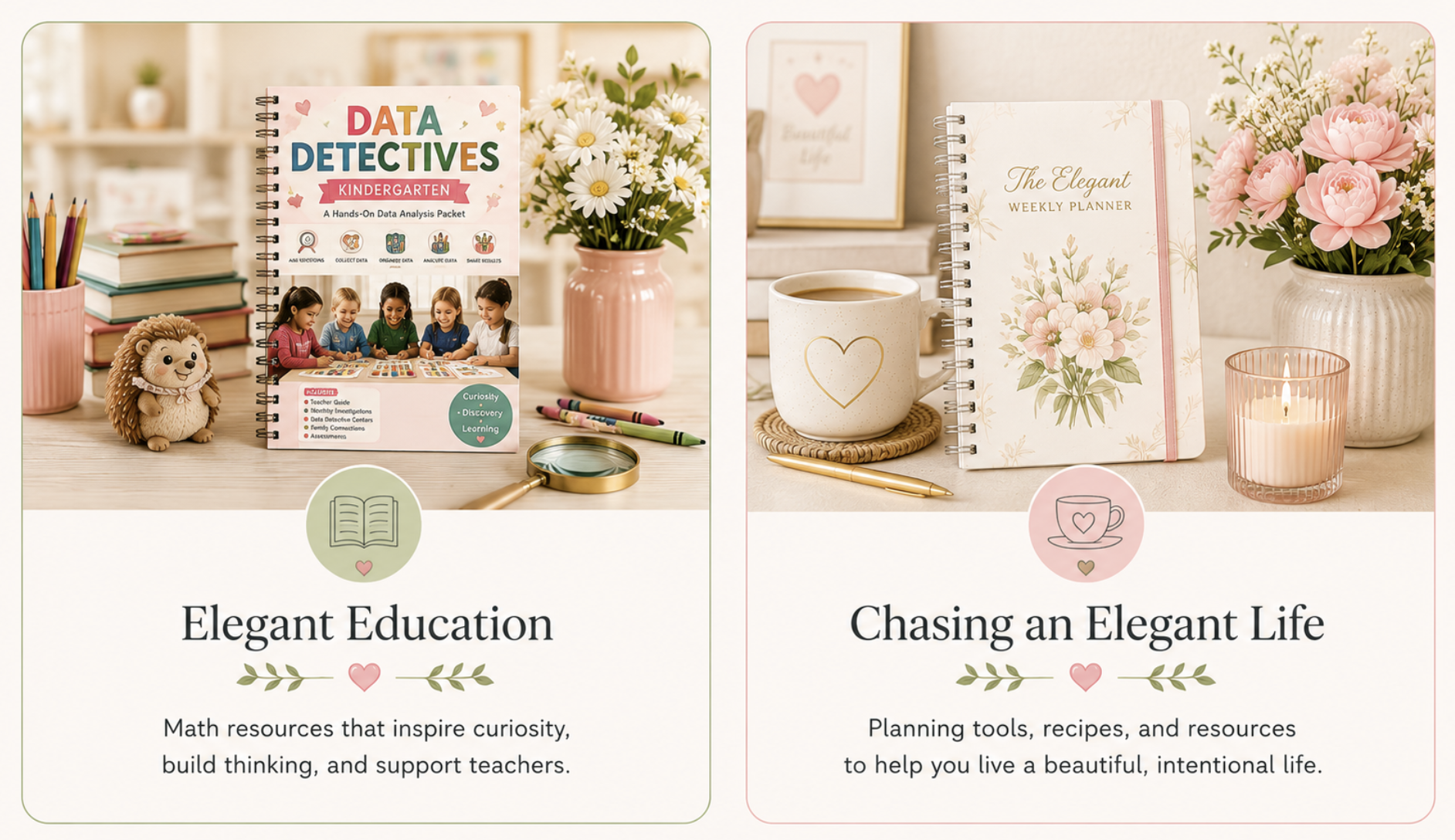


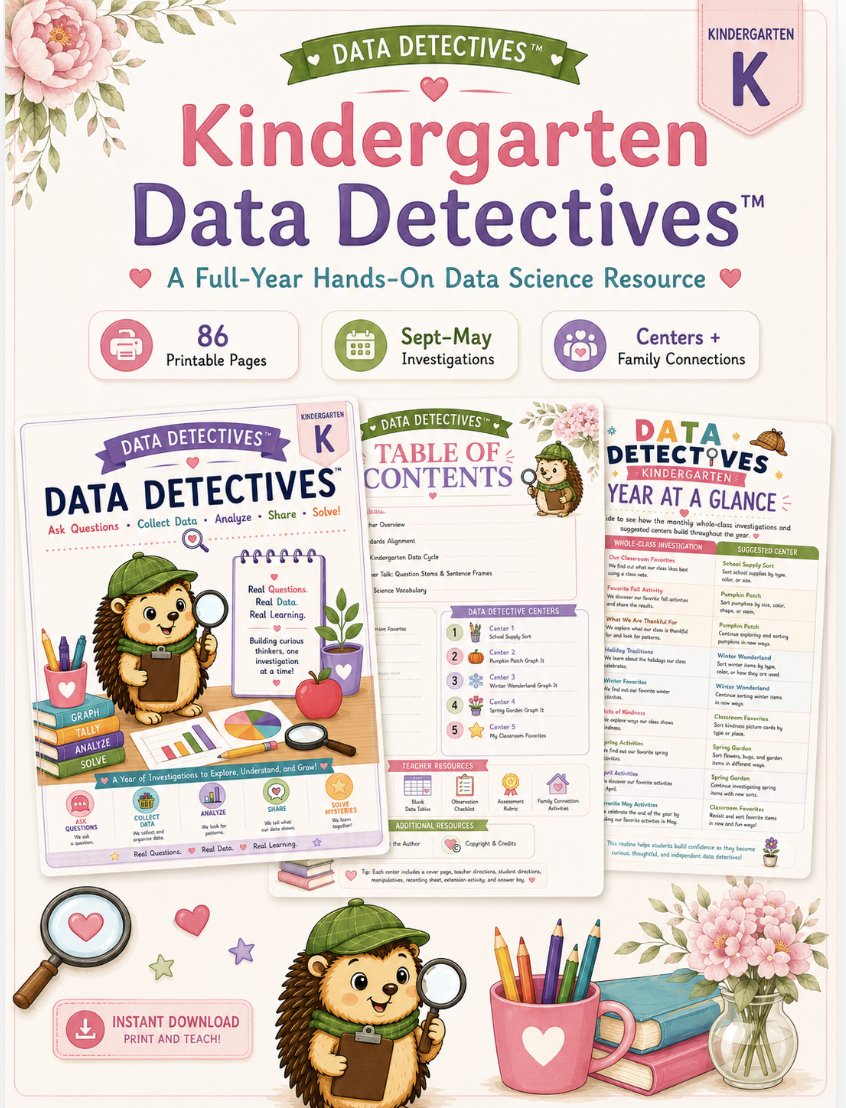
Bring data science to life for your youngest learners with Kindergarten Data Detectives™, a joyful, hands-on resource designed to help students ask questions, collect data, notice patterns, share results, and solve problems all year long.
This printable kindergarten data science resource turns real classroom questions into meaningful investigations students can understand and enjoy. With colorful visuals, student-friendly routines, teacher guidance, picture cards, recording sheets, family connection pages, assessment tools, and engaging centers, students begin to see that data is not just numbers on a chart. It is a way to explore their classroom, their community, and the world around them.
Designed especially for kindergarten, this resource supports students as they practice sorting, counting, organizing information, creating picture graphs, using tally marks, comparing results, and explaining what their data shows. The included year-at-a-glance page outlines monthly whole-class investigations from September through May, along with suggested data centers to extend learning throughout the year.
What’s Included
This 86-page printable resource includes:
Teacher Support Pages
Teacher overview, standards alignment, kindergarten data cycle, question stems, sentence frames, vocabulary, differentiation ideas, observation checklist, and assessment rubric.
Whole-Class Investigations
Monthly investigations that guide students through asking a question, collecting information, noticing patterns, and sharing results. Topics include classroom favorites, fall activities, thankfulness, holiday traditions, winter favorites, kindness, spring activities, April activities, and favorite May activities.
Data Detective Centers
Hands-on centers for sorting, graphing, tallying, patterning, and solving data questions. Centers include school supplies, pumpkins, winter, spring garden, and classroom favorites.
Printable Student Materials
Picture cards, student recording sheets, blank picture graphs, blank data tables, data result pages, extension activities, and reproducibles to support whole-class lessons, small groups, centers, and independent practice.
Family Connection Activities
Take-home pages that help students continue exploring data with their families through surveys, picture graphs, data hunts, comparing, and talking about results.
Perfect For
Kindergarten data lessons, math centers, graphing units, sorting activities, tally mark practice, picture graph lessons, whole-class investigations, small-group instruction, early STEM lessons, family engagement, and standards-based math enrichment.
Why Teachers Will Love It
This resource gives teachers everything they need to introduce data science in a developmentally appropriate, playful, and meaningful way. The lessons are simple to follow, the routines repeat across the year, and the visuals help young learners build confidence as they grow into curious little data detectives.
Elegant Weekly Planner
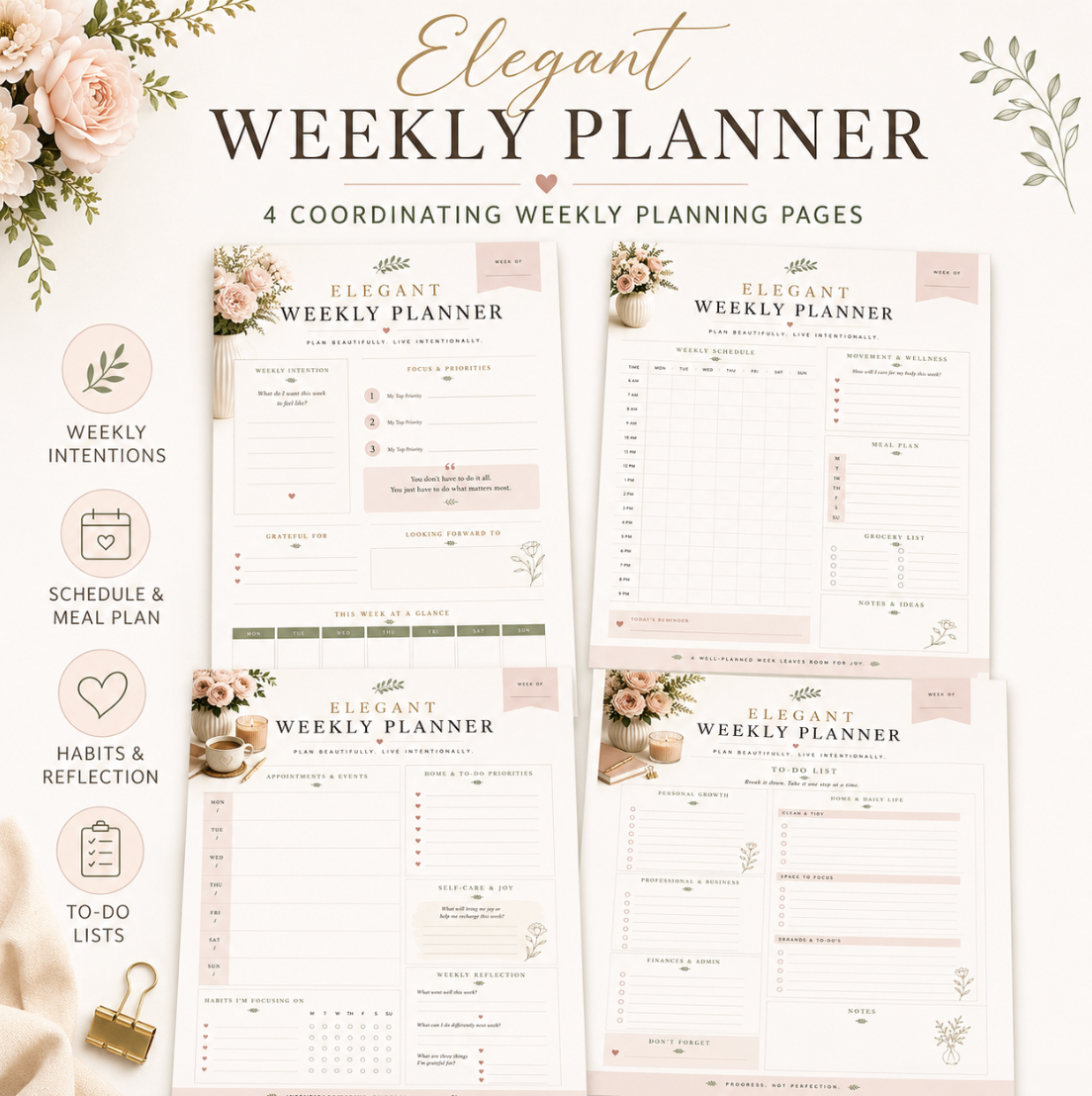
Plan your week with clarity, beauty, and intention using the Elegant Weekly Planner, a soft floral planning set designed to help you organize your schedule, priorities, wellness, meals, habits, and personal goals in one graceful space.
With its blush pink accents, delicate floral details, soft greenery, and clean minimalist layout, this planner brings a calm, feminine touch to weekly organization. Whether you are managing appointments, meal planning, tracking habits, setting intentions, or simply creating more room for joy, each page is thoughtfully designed to make planning feel peaceful instead of overwhelming.
This 4-page weekly planner includes dedicated sections for weekly intentions, top priorities, gratitude, daily scheduling, movement and wellness, meal planning, grocery lists, appointments, habit tracking, self-care, reflection, categorized to-do lists, notes, and reminders. It is perfect for home organization, work planning, personal growth, lifestyle routines, and mindful weekly resets.
Features
Includes 4 beautifully designed weekly planning pages:
Weekly Overview Page
Set your weekly intention, choose your top priorities, reflect on gratitude, note what you are looking forward to, and map out your week at a glance.
Weekly Schedule Page
Organize your days from 6 AM to 9 PM, with extra space for wellness goals, meal planning, grocery lists, reminders, notes, and ideas.
Appointments, Habits & Reflection Page
Track appointments, events, home priorities, habits, self-care plans, weekly wins, gratitude, and areas for improvement.
Categorized To-Do List Page
Break tasks into simple sections including personal growth, professional and business, finances and admin, home and daily life, clean and tidy, errands, focus space, notes, and don’t-forget reminders.
Perfect For
Weekly planning, intentional living, home organization, work-from-home routines, self-care planning, meal planning, habit tracking, goal setting, and creating a more balanced week.
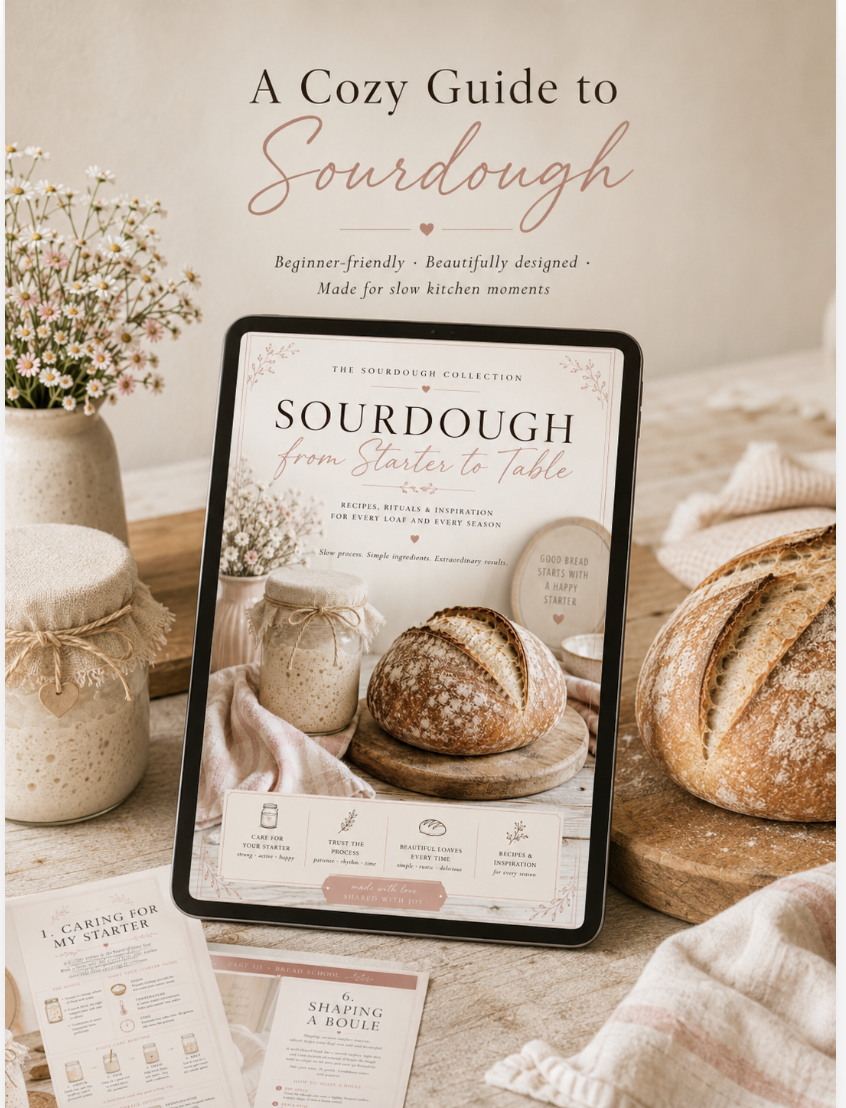
Bring the quiet magic of sourdough into your kitchen with The Sourdough Guide, a warm and practical resource designed for beginner and growing bakers.
This guide helps take the guesswork out of sourdough by walking you through the rhythms of starter care, feeding schedules, dough strength, fermentation, shaping, scoring, baking, and troubleshooting. Whether you are just meeting your starter or ready to bake your first rustic boule, this guide gives you the support you need to feel calm, capable, and confident.
Inside, you will find helpful explanations, beautiful printable pages, starter care guidance, bread school basics, recipe support, journaling space, and cozy ideas for serving and sharing your bread. It is part baking guide, part kitchen journal, and part invitation to slow down and create something nourishing with your own hands.
What’s Included
Sourdough starter care guidance
Meet My Starter page
Feeding schedules
Refrigerator vs. counter care
Vacation care tips
When your starter is ready to bake
Reviving a neglected starter
Troubleshooting guide
Starter discard guide
Bread school basics
Stretch and fold guidance
Coil fold guidance
Bulk fermentation help
Reading the dough
Shaping a boule
Scoring basics
Dutch oven baking tips
Cooling and crumb structure guidance
Flour and hydration explanations
Rustic sourdough boule recipe support
Sourdough journal pages
Serving ideas, bread boards, spreads, jams, and gathering inspiration
Perfect For
New sourdough bakers
Home bakers who want more confidence
Anyone starting a sourdough starter
Bakers who want a pretty, practical kitchen reference
Gift-giving for bread lovers
Slow living, homemaking, and cozy kitchen enthusiasts


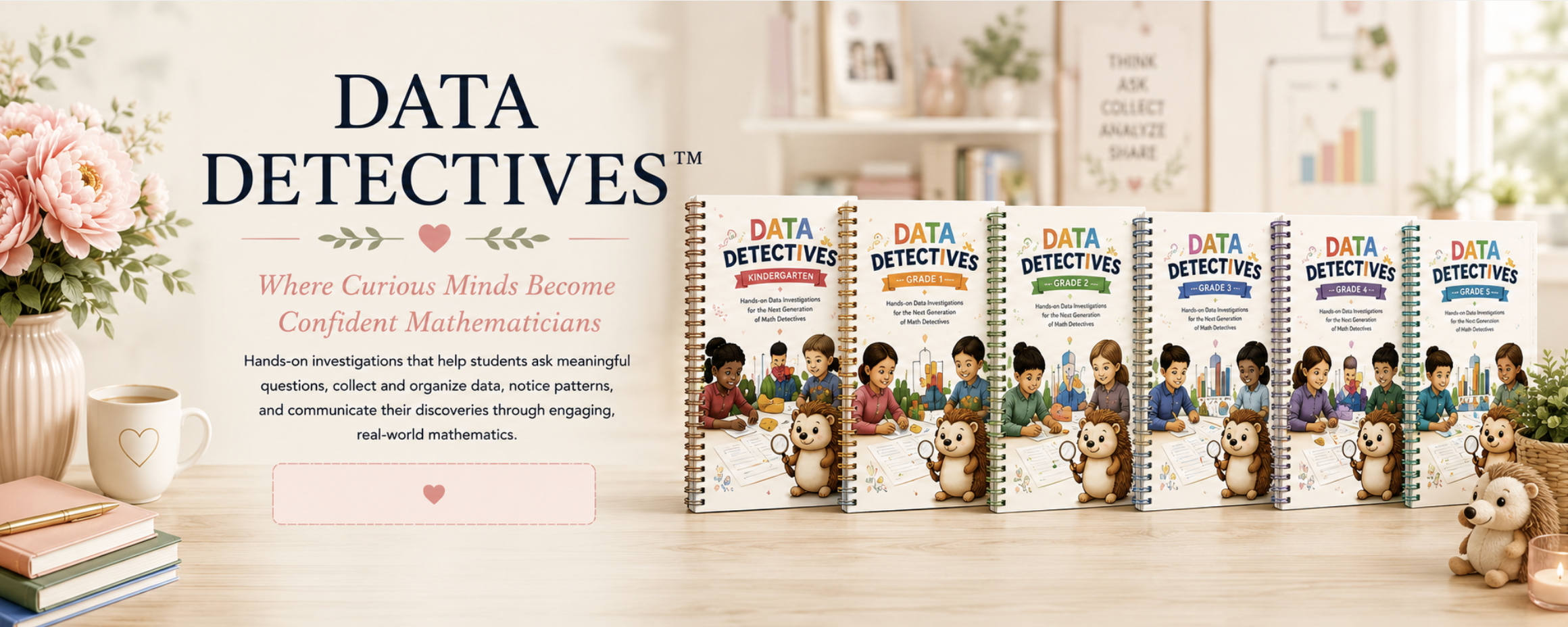
Bring data science to life through engaging investigations that help students ask meaningful questions, collect and organize data, analyze results, and communicate their thinking with confidence.
This interactive workshop is designed for elementary teachers who want practical, standards-aligned lessons that make data meaningful, engaging, and accessible for every learner.
Workshop Details
📍 Location
Union Gap School District
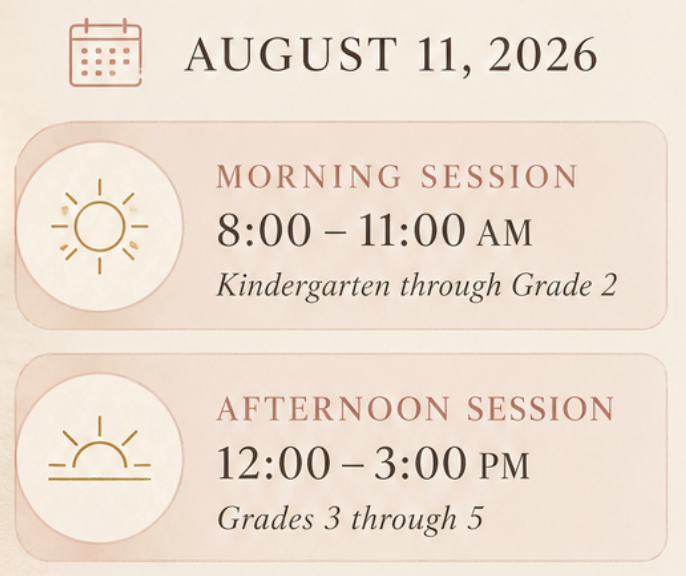
🗓 Date
Tuesday, August 11, 2026
☀ Morning Session | Kindergarten-Grade 2
8:00 AM-11:00 AM
🌤 Afternoon Session | Grades 3-5
12:00 PM-3:00 PM
💲 Investment
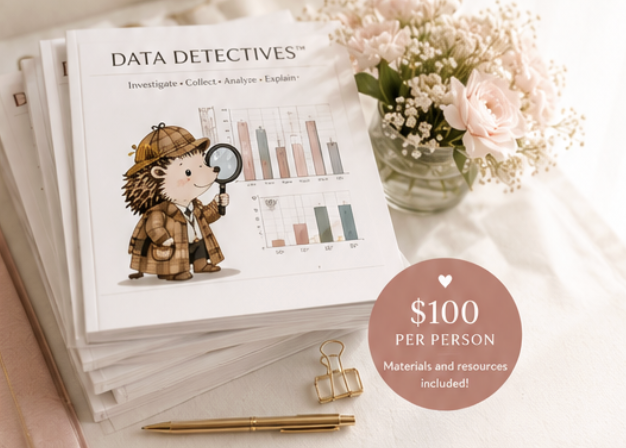
$100 per participant
You'll Leave With
✔ Ready-to-use classroom investigations
✔ Standards-aligned instructional resources
✔ Student recording pages and assessment ideas
✔ Strategies for building meaningful classroom conversations
✔ Confidence teaching Washington's Data Science Standards
✔ Ideas you can implement the very next day
Perfect For
Classroom teachers
Instructional coaches
Intervention specialists
Building administrators
Professional Learning Communities
Call to Action
Ready to bring data science to your classroom?
Registration is now open for the August workshop. Space is limited to help ensure an engaging, hands-on learning experience.

Professional Development
Practical learning. Meaningful impact.
Whether you're introducing new mathematical ideas, strengthening instructional practices, or building a culture of curiosity, every professional learning experience is thoughtfully designed with one goal in mind: helping teachers create classrooms where students truly thrive.
As an independent mathematics consultant with years of experience partnering with schools across Washington, I believe the best professional development is practical, engaging, and immediately applicable. Every session is rooted in current research, aligned to standards, and filled with strategies you can confidently use the very next day.
Together, we'll move beyond simply teaching mathematics to creating classrooms where students wonder, investigate, explain, and grow.
Bring data science to life for your youngest learners with Kindergarten Data Detectives™, a joyful, hands-on resource designed to help students ask questions, collect data, notice patterns, share results, and solve problems all year long.
This printable kindergarten data science resource turns real classroom questions into meaningful investigations students can understand and enjoy. With colorful visuals, student-friendly routines, teacher guidance, picture cards, recording sheets, family connection pages, assessment tools, and engaging centers, students begin to see that data is not just numbers on a chart. It is a way to explore their classroom, their community, and the world around them.
Designed especially for kindergarten, this resource supports students as they practice sorting, counting, organizing information, creating picture graphs, using tally marks, comparing results, and explaining what their data shows. The included year-at-a-glance page outlines monthly whole-class investigations from September through May, along with suggested data centers to extend learning throughout the year.
What’s Included
This 86-page printable resource includes:
Teacher Support Pages
Teacher overview, standards alignment, kindergarten data cycle, question stems, sentence frames, vocabulary, differentiation ideas, observation checklist, and assessment rubric.
Whole-Class Investigations
Monthly investigations that guide students through asking a question, collecting information, noticing patterns, and sharing results. Topics include classroom favorites, fall activities, thankfulness, holiday traditions, winter favorites, kindness, spring activities, April activities, and favorite May activities.
Data Detective Centers
Hands-on centers for sorting, graphing, tallying, patterning, and solving data questions. Centers include school supplies, pumpkins, winter, spring garden, and classroom favorites.
Printable Student Materials
Picture cards, student recording sheets, blank picture graphs, blank data tables, data result pages, extension activities, and reproducibles to support whole-class lessons, small groups, centers, and independent practice.
Family Connection Activities
Take-home pages that help students continue exploring data with their families through surveys, picture graphs, data hunts, comparing, and talking about results.
Perfect For
Kindergarten data lessons, math centers, graphing units, sorting activities, tally mark practice, picture graph lessons, whole-class investigations, small-group instruction, early STEM lessons, family engagement, and standards-based math enrichment.
Why Teachers Will Love It
This resource gives teachers everything they need to introduce data science in a developmentally appropriate, playful, and meaningful way. The lessons are simple to follow, the routines repeat across the year, and the visuals help young learners build confidence as they grow into curious little data detectives.
A Year-Long Data Science Investigation for Curious Thinkers
Transform your Grade 3 classroom into a team of junior investigators where every question becomes a case to solve.
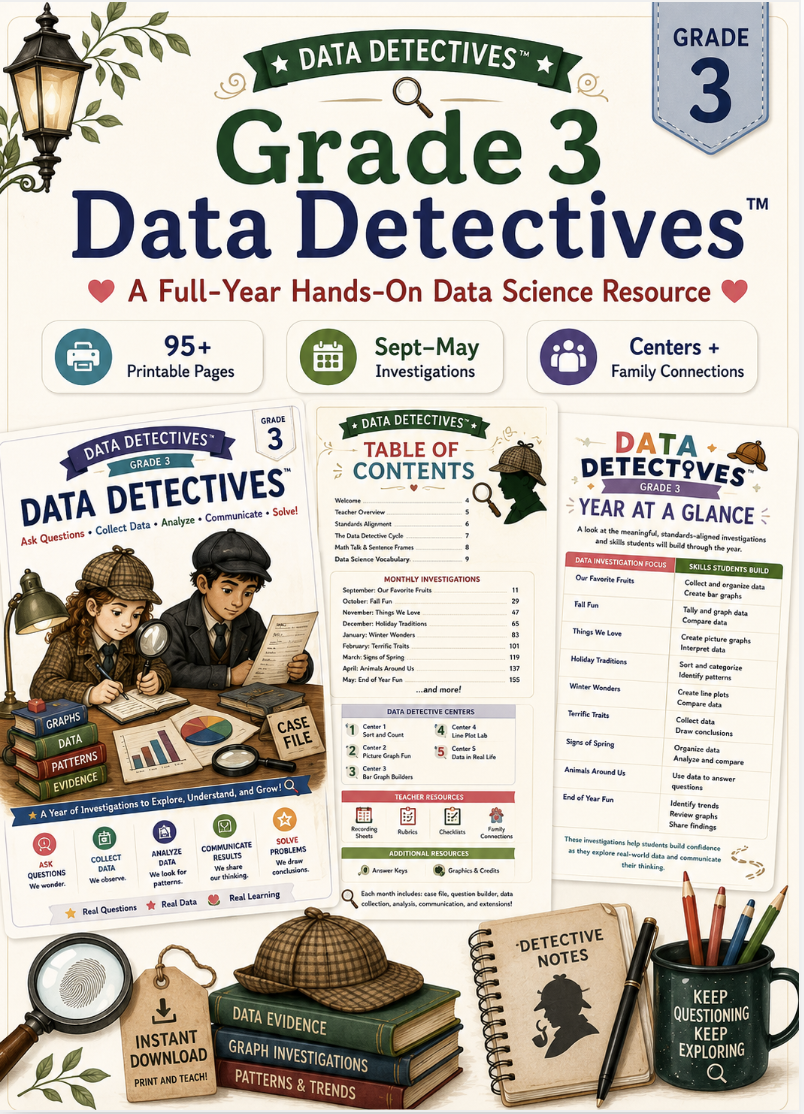
Data Detectives™ Grade 3 is a comprehensive, year-long curriculum that blends data science, mathematical reasoning, and engaging storytelling to help students develop the skills of real investigators. Through immersive "case files," students learn to ask meaningful statistical questions, collect and organize data, analyze evidence, identify patterns, and communicate their conclusions with confidence.
Designed specifically for Washington's Grade 3 Data Science Standards, this resource makes teaching data science engaging, structured, and easy to implement while encouraging students to think critically and reason like mathematicians.
What's Included
Complete teacher guide with implementation support
Standards alignment and year-at-a-glance planning
Nine monthly investigations
Story-driven "Case Files" featuring Detective Ada Vale and Dr. Theodore Quill
Student investigation journals and recording pages
Data collection tools and graphic organizers
Bar graphs, scaled picture graphs, and line plot activities
Vocabulary and academic language supports
Reflection prompts and writing activities
Assessment rubrics and observation checklists
Differentiation strategies
Family connection activities
Extension challenges for deeper thinking
Students Will Learn To
Formulate meaningful statistical investigative questions
Design fair methods for collecting data
Organize and represent data using appropriate graphs
Analyze patterns, trends, and variability
Compare data sets and justify conclusions with evidence
Communicate mathematical thinking using precise language
Solve authentic data investigations through collaborative inquiry
Perfect For
Grade 3 Classrooms
Data Science Instruction
Mathematics Centers
Small Group Intervention
Enrichment Opportunities
Project-Based Learning
STEM Integration
Classroom Investigations
Whether you're introducing statistical investigations for the first time or expanding your current mathematics program, Data Detectives™ Grade 3 provides everything you need to build confident, curious, data-literate learners through engaging investigations that students will look forward to solving all year long.
Hands-On Data Investigations for Curious Young Mathematicians
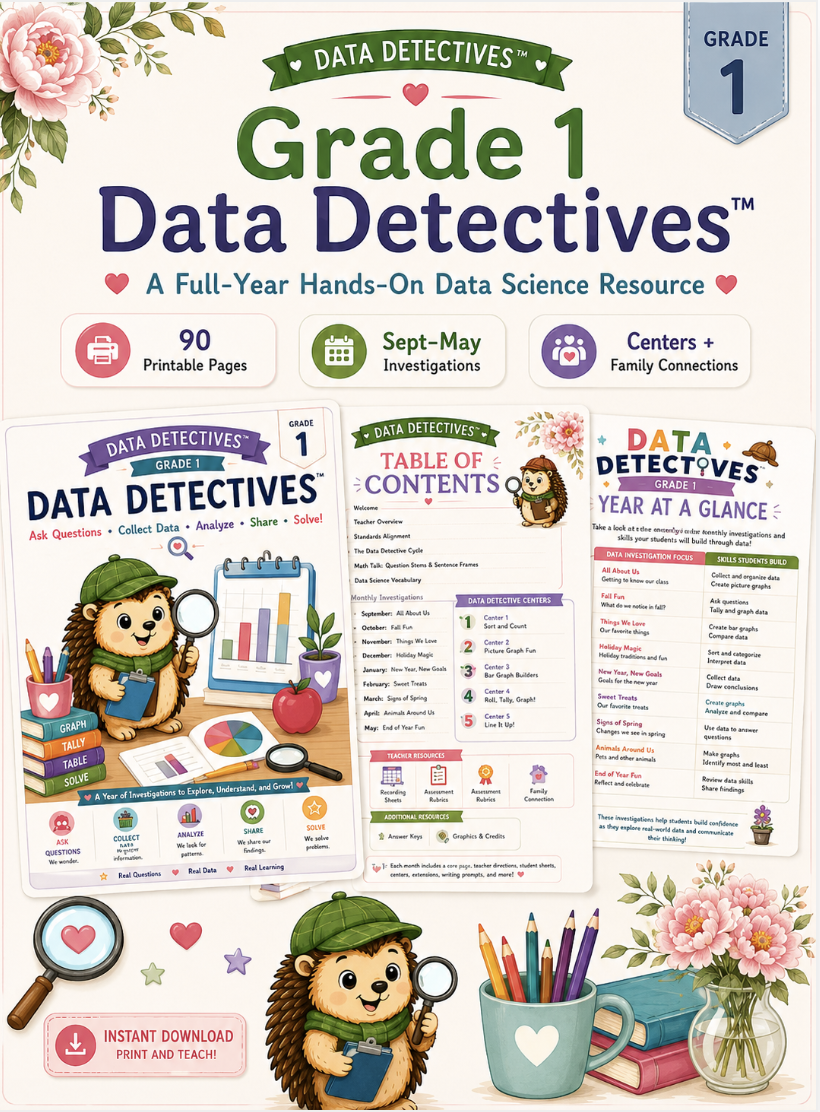
Empower first graders to become confident mathematical thinkers through engaging, real-world data investigations. Data Detectives™ Grade 1 guides students through asking questions, collecting and organizing information, creating graphs, analyzing results, and communicating their discoveries using developmentally appropriate activities that build both mathematical understanding and critical thinking.
Designed for busy teachers, each investigation is easy to implement while encouraging rich classroom conversations, collaboration, and authentic problem-solving.
What's Included
📚 Comprehensive Teacher Guide
🗓️ 9 Monthly Data Investigations (September through May)
📊 Student Recording Sheets
📈 Blank Graph Templates
📝 Data Detective Notes
🎯 Assessment Rubrics
👨👩👧 Family Connection Activities
🎲 Hands-On Data Detective Centers
💬 Math Discussion Prompts & Sentence Frames
📖 Standards-Aligned Lessons
Students Will Learn To
Ask meaningful statistical questions
Collect and organize real-world data
Create and interpret picture graphs, bar graphs, and tables
Compare and analyze data sets
Identify patterns and trends
Explain mathematical thinking using evidence
Communicate conclusions with confidence
Perfect For
Whole-class instruction
Math workshop
Small groups
Intervention
Math centers
Homeschool learning
Substitute-friendly lessons
Why Teachers Love Data Detectives™
❤️ Ready-to-teach investigations with minimal prep
❤️ Beautifully designed, engaging student pages
❤️ Encourages mathematical discourse and critical thinking
❤️ Consistent investigation routine that builds confidence all year
❤️ Easily integrates into existing math instruction
❤️ Reusable year after year
Standards Alignment
Data Detectives™ Grade 1 aligns with Grade 1 data and statistics standards while reinforcing essential mathematical practices, including problem solving, reasoning, communication, and mathematical modeling.
Instant Digital Download
This is a printable PDF resource designed for classroom and personal educational use. Simply download, print, and begin investigating!
You May Also Love
Continue the Data Detectives™ series with:
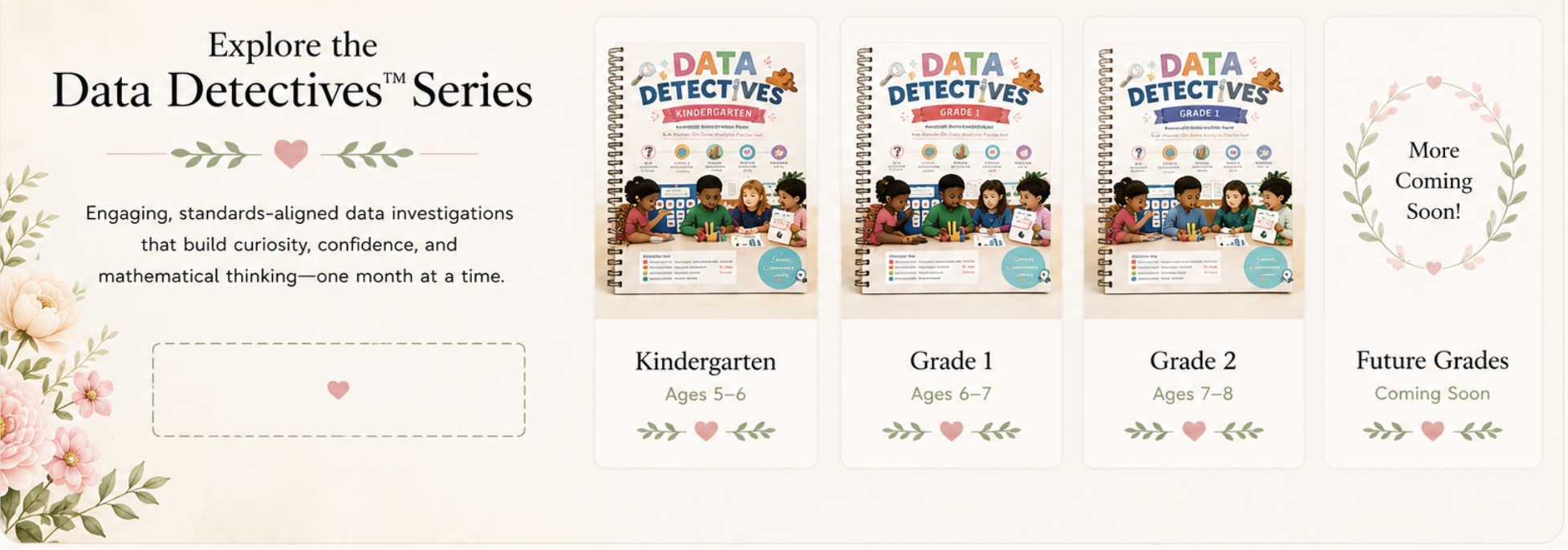
Data Detectives™ Kindergarten
Data Detectives™ Grade 2
Data Detectives™ Grade 3 (Coming Soon)
Data Detectives™ Grade 4 (Coming Soon)
Data Detectives™ Grade 5 (Coming Soon)
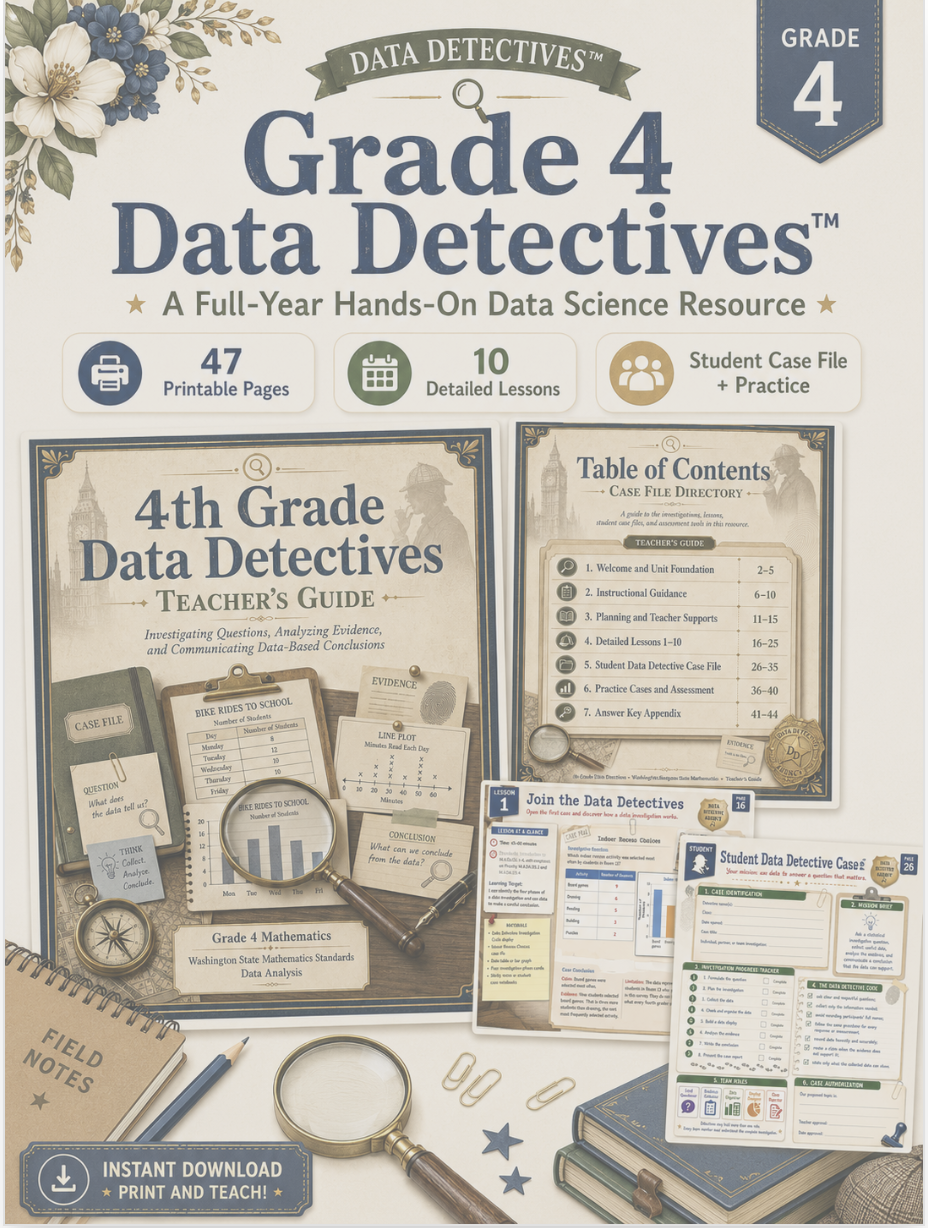
A Year-Long Data Science Investigation for Critical Thinkers
Turn your students into skilled data detectives as they investigate authentic questions, evaluate evidence, analyze data, and communicate well-supported conclusions.
Data Detectives™ Grade 4 is a comprehensive, standards-aligned curriculum that transforms data analysis into an engaging detective experience. Students progress through a complete investigation cycle as they formulate statistical questions, design fair data collection plans, organize and display evidence, analyze patterns, evaluate claims, and present evidence-based conclusions.
Designed specifically for Washington's Grade 4 Data Science Standards, this resource provides everything teachers need to develop confident mathematical thinkers while making data investigations meaningful, rigorous, and memorable.
What's Included
Comprehensive teacher guide with implementation support
Standards alignment and instructional planning
10 sequential detective investigations
Teacher lesson plans and instructional guidance
Student Data Detective Case File
Investigation planning and recording pages
Graphing templates and data displays
Data analysis and conclusion organizers
Practice investigations and assessment tasks
Performance rubric and answer keys
Differentiation strategies and teacher supports
Printable student resources ready to use
Students Will Learn To
Generate meaningful statistical investigative questions
Develop fair and effective data collection plans
Organize, display, and analyze real-world data
Compare groups, identify patterns, and evaluate evidence
Challenge claims using mathematical reasoning
Communicate conclusions supported by data
Complete an entire statistical investigation from question to final report
Perfect For
Grade 4 Mathematics
Data Science Instruction
Project-Based Learning
STEM Integration
Small Group Instruction
Intervention & Enrichment
Independent Investigations
End-of-Unit Performance Tasks
Every lesson builds upon the previous one, guiding students through the complete data investigation process while strengthening mathematical reasoning, communication, and critical thinking. By the end of the unit, students confidently conduct and present their own authentic data investigations using evidence to support every conclusion.
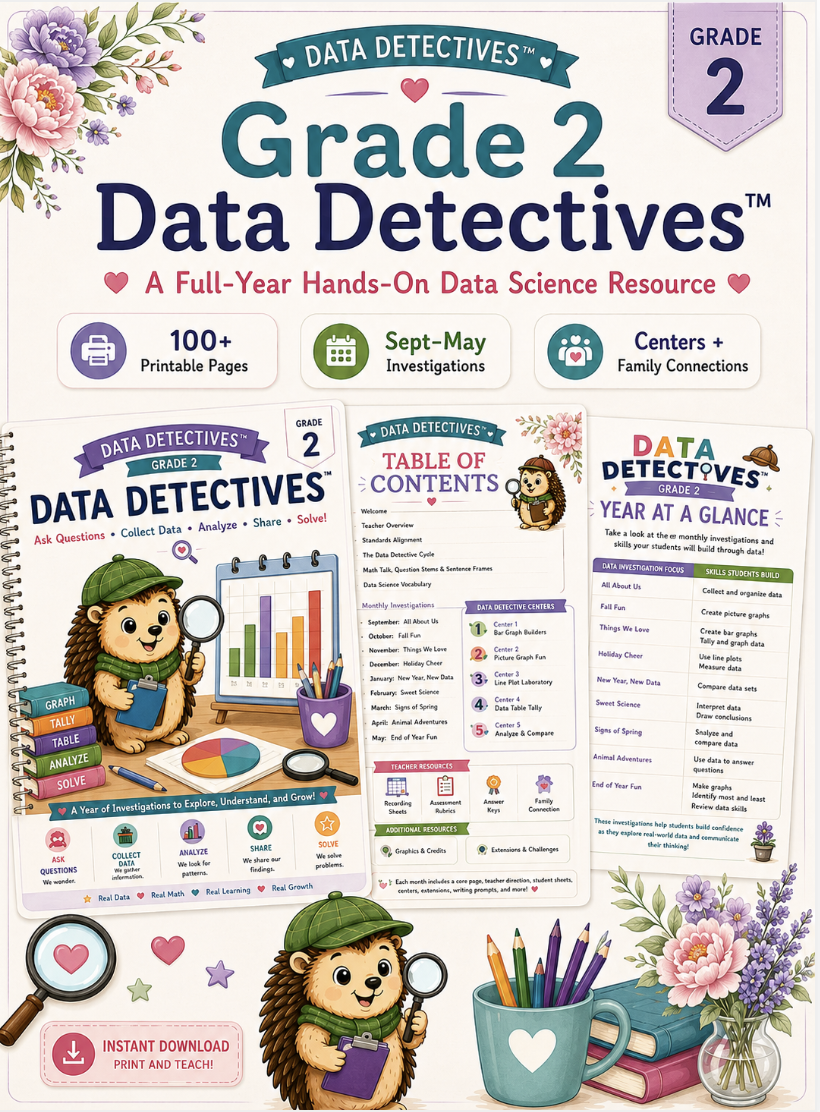
Hands-On Data Investigations for Curious Young Mathematicians
Inspire second graders to think like mathematicians as they investigate meaningful questions, organize and represent data, identify patterns, and communicate their reasoning with confidence. Data Detectives™ Grade 2 builds on students' prior experiences with data by introducing more sophisticated investigations, multiple graph types, and deeper opportunities for analysis and interpretation.
Designed with busy teachers in mind, each investigation is simple to implement while promoting mathematical discussion, collaboration, and authentic problem-solving through engaging, real-world contexts.
What's Included
📚 Comprehensive Teacher Guide
🗓️ 9 Monthly Data Investigations (September through May)
📊 Student Recording Sheets
📈 Blank Graph Templates (Bar Graphs, Picture Graphs & Line Plots)
📝 Data Detective Notes
🎯 Assessment Rubrics
👨👩👧 Family Connection Activities
🎲 Hands-On Data Detective Centers
💬 Math Discussion Prompts & Sentence Frames
📖 Standards-Aligned Lessons
Students Will Learn To
Ask meaningful statistical investigative questions
Collect, organize, and represent real-world data
Create and interpret picture graphs, bar graphs, and line plots
Compare multiple data sets and identify patterns
Draw conclusions using mathematical evidence
Explain and justify their thinking using data
Communicate findings with confidence using mathematical vocabulary
Perfect For
Whole-class instruction
Math workshop
Small groups
Intervention
Math centers
Homeschool learning
Substitute-friendly lessons
Why Teachers Love Data Detectives™
❤️ Ready-to-teach investigations with minimal prep
❤️ Beautifully designed, engaging student pages
❤️ Encourages mathematical discourse and critical thinking
❤️ Consistent investigation routine that builds confidence all year
❤️ Easily integrates into existing math instruction
❤️ Reusable year after year
Standards Alignment
Data Detectives™ Grade 2 aligns with Grade 2 data and statistics standards while strengthening students' ability to investigate questions, represent data in multiple ways, analyze patterns, and communicate mathematical reasoning through authentic, hands-on learning experiences.
Instant Digital Download
This is a printable PDF resource designed for classroom and personal educational use. Simply download, print, and begin investigating!
You May Also Love
Continue the Data Detectives™ series with:
Data Detectives™ Kindergarten
Data Detectives™ Grade 1
Data Detectives™ Grade 3 (Coming Soon)
Data Detectives™ Grade 4 (Coming Soon)
Data Detectives™ Grade 5 (Coming Soon)
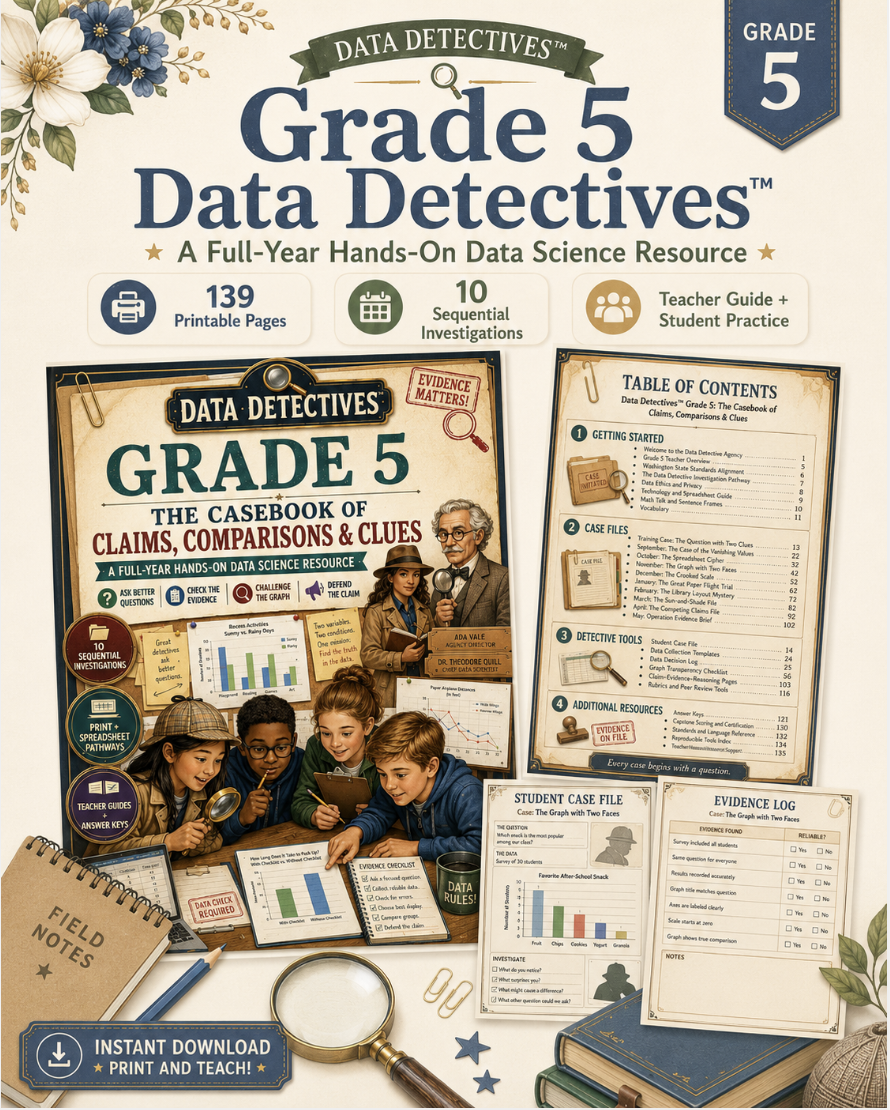
Welcome to the Data Detective Agency, where every number is a clue and every conclusion must survive the evidence.
5th Grade Data Detectives™: The Casebook of Claims, Comparisons & Clues is a full-year data science resource that guides students through a training case and nine monthly investigations from September through May.
Students do far more than construct graphs. They examine how data were collected, identify missing or questionable values, document data-cleaning decisions, compare multiple representations, investigate misleading graph design, and determine what the evidence does and does not support.
Each investigation combines an engaging case narrative with teacher guidance, student briefs, raw evidence, data-decision logs, visualizations, numerical reasoning, peer review, and evidence-based conclusions. The year culminates in Operation: Evidence Brief, an independent or team capstone in which students design and present a complete comparative data investigation.
The resource may be used as a monthly investigation sequence, a full-year data-analysis strand, an enrichment program, or a collection of performance tasks and assessments.
The 10 investigations
Training Case: The Question with Two Clues
Formulate and refine comparative statistical questions.September: The Case of the Vanishing Values
Find missing, duplicate, inconsistent, and questionable data.October: The Spreadsheet Cipher
Organize, sort, filter, standardize, and analyze spreadsheet data.November: The Graph with Two Faces
Compare tables, grouped bar graphs, and spreadsheet-generated charts.December: The Crooked Scale
Investigate truncated axes, unequal intervals, omitted evidence, distorted symbols, and loaded titles.January: The Great Paper Flight Trial
Conduct repeated trials and compare numerical distributions with aligned line plots.February: The Library Layout Mystery
Use matched searches and balanced condition order to compare search times.March: The Sun-and-Shade File
Collect and compare matched-pair surface-temperature measurements.April: The Competing Claims File
Audit two supported claims and decide which evidence is most relevant to a stated goal.May: Operation Evidence Brief
Design, complete, review, and present an original comparative data investigation.
Students will learn to
Formulate and refine statistical questions that compare two variables.
Identify the group, setting, variables, and expected variation.
Plan safe, ethical, and realistic data-collection procedures.
Protect privacy and use anonymous participant or location identifiers.
Preserve raw evidence and document every data decision.
Identify missing, duplicate, inconsistent, invalid, and questionable values.
Use tables, bar graphs, line plots, spreadsheets, and matched-pair displays.
Compare ranges, overlap, clusters, category counts, paired differences, and threshold success.
Distinguish an accurate display from a transparent display.
Analyze truncated scales, omitted information, distorted images, and unsupported titles.
Write claims supported by specific numerical evidence.
State limitations and avoid unsupported causal conclusions.
Challenge reasoning respectfully through peer review.
Communicate a complete evidence brief.
Teacher support included
Grade 5 teacher overview
Full investigation pathway
Data ethics and privacy guidance
Technology-ready, technology-light, and no-device pathways
Spreadsheet anatomy and safety guidance
Math-talk prompts and evidence-based sentence frames
Grade 5 data-analysis vocabulary
Year-at-a-glance investigation sequence
Teacher intelligence pages for every case
Standards focus and learning goals
Suggested pacing
Materials and preparation guidance
Common misconceptions and teacher responses
Differentiation and language supports
Teacher look-fors
Assessment strips and scoring guidance
Case answer keys
Capstone teacher key
24-point capstone scoring guide
Lead Data Investigator certificate
Standards and language reference pages
Reproducible tools index
Standards alignment
The resource aligns to the current Washington Grade 5 Data Analysis strand:
M.5.DA.DS.1: Formulate statistical investigative questions.
M.5.DA.DS.2: Collect and consider data, including data-quality decisions.
M.5.DA.DS.3: Analyze and compare data visualizations.
M.5.DA.DS.4: Interpret results and communicate evidence-based conclusions.
The resource gives priority attention to M.5.DA.DS.3 and M.5.DA.DS.4 while integrating the complete inquiry cycle across all four standards. Current OSPI mathematics materials list these Grade 5 Data Analysis codes and describe the WA Math 2026 standards as centering the data science inquiry cycle.